The market for text to speech APIs has grown crowded in recent years, with well-funded labs and hyperscalers competing to deliver the most natural-sounding synthetic voices. Yet many enterprise developers remain caught between two unappealing options: premium models priced beyond the reach of production workloads, or affordable alternatives that fall short on quality and latency.
Speechify, the company behind the consumer products used by more than 60 million people, is now positioning its developer arm, SpeechifyAI, as a third path built for scale rather than the benchmark leaderboard alone.
Simba 3.2 as a Milestone in Voice Model Development
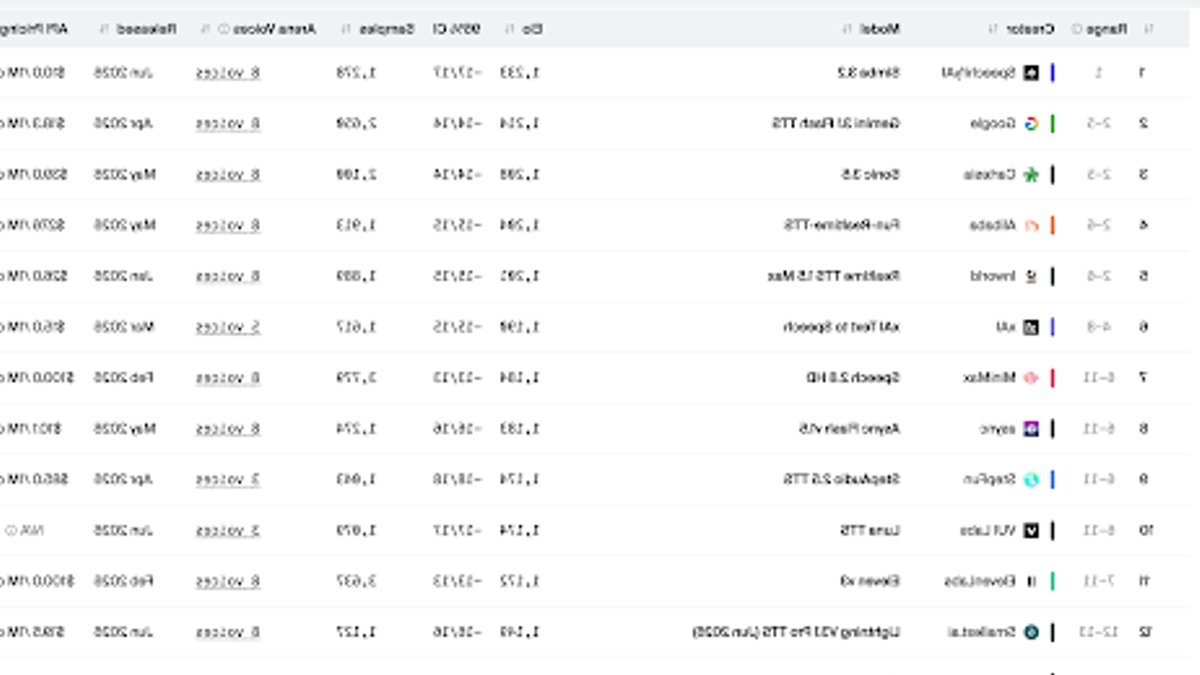
Simba 3.2, the company’s newest model, took the No. 1 overall position on Artificial Analysis, widely regarded as the most independent leaderboard for AI voice models. This ranking places Simba 3.2 above offerings from ElevenLabs, Cartesia, OpenAI, Google DeepMind, and xAI, and represents the first time a consumer-focused speech company has led the global rankings.
The model also holds the joint-second position on Voice Arena, an evaluation platform where users compare voice outputs blind. For SpeechifyAI, the result reflects nearly five years of focused research.
Related: Senator Lindsey Graham dies unexpectedly
Enhancing the Economics of Production-Grade Voice
Co-founder and Head of AI, Tyler Weitzman, began the work while an undergraduate at Stanford University, initially fine-tuning early neural speech architectures for a graduate machine learning course. That research direction has since evolved into the Simba model family, which now powers streaming voice generation across the company’s consumer and enterprise products.
Tyler Weitzman said his interest in ML was sparked by a course at Stanford, CS229 with Andrew Ng, where he fine-tuned Tacotron 2. His team’s new model at Speechify just hit SOTA, five years later.
What separates Simba 3.2 from other top-ranked models, according to the company, is its price point. SpeechifyAI has priced access at $10 per one million characters at the entry tier and $6 at scale, making it the most cost-efficient model among the top ten on the Artificial Analysis leaderboard.
A Consumer DNA Applied to Enterprise AI
Company leadership frames this as roughly fifteen times more affordable than ElevenLabs and six times more affordable than Cartesia at comparable quality. Rohan Pavuluri, SpeechifyAI’s Chief Business Officer, who has known Tyler Weitzman since high school, framed the moment as the culmination of a specific strategic choice.
Related: Iran Holds Khamenei Funeral As Mediators Push Truce
Speechify’s Simba 3.2 hits the No. 1 overall slot on Artificial Analysis overall global speech leaderboard, which includes U.S. & Chinese models, hyperscalers, labs, and startups.
They added that while they may have been able to go faster, just focused on quality, their consumer DNA and business model called for architecture decisions early on to make sure they could provide unlimited speech to their users for $139/year. This translates into what is today the SOTA TTS model at the best-in-class price, which is rare in AI research.
The trade-off between quality, cost, and latency has historically been treated as a structural constraint in speech synthesis, with most providers optimizing for one dimension at the expense of the others. Speechify’s engineering leadership takes a different view.
Given the current state of AI voice development, Speechify’s approach could lead to a shift in how companies prioritize their investments in this area, as they weigh the benefits of high-quality voice models against the costs of deployment and maintenance.
Related: Crimea Declared Emergency Amid Ukrainian Attacks
Raheel Kazi, who leads engineering on the model, said the outcome reflects a deliberate choice made years earlier. They never wanted to sacrifice on cost to chase quality, or sacrifice on quality to chase latency. They took the harder route on purpose. Hitting SOTA on all three at once is what that decision was always for.
The launch of Simba 3.2 arrives alongside the broader rollout of Speechify’s Developer Platform, which pairs SpeechifyAI Build for text-to-speech, and voice cloning, with the newly released SpeechifyAI Agents — both powered by Simba 3.2 and available at speechify.ai. Together, they mark the company’s shift from a category-defining consumer app toward becoming an infrastructure provider for the wider voice AI ecosystem.
They may start to prioritize affordability and scalability in their AI voice investments, in addition to quality and latency, if the current leaderboard position holds.


