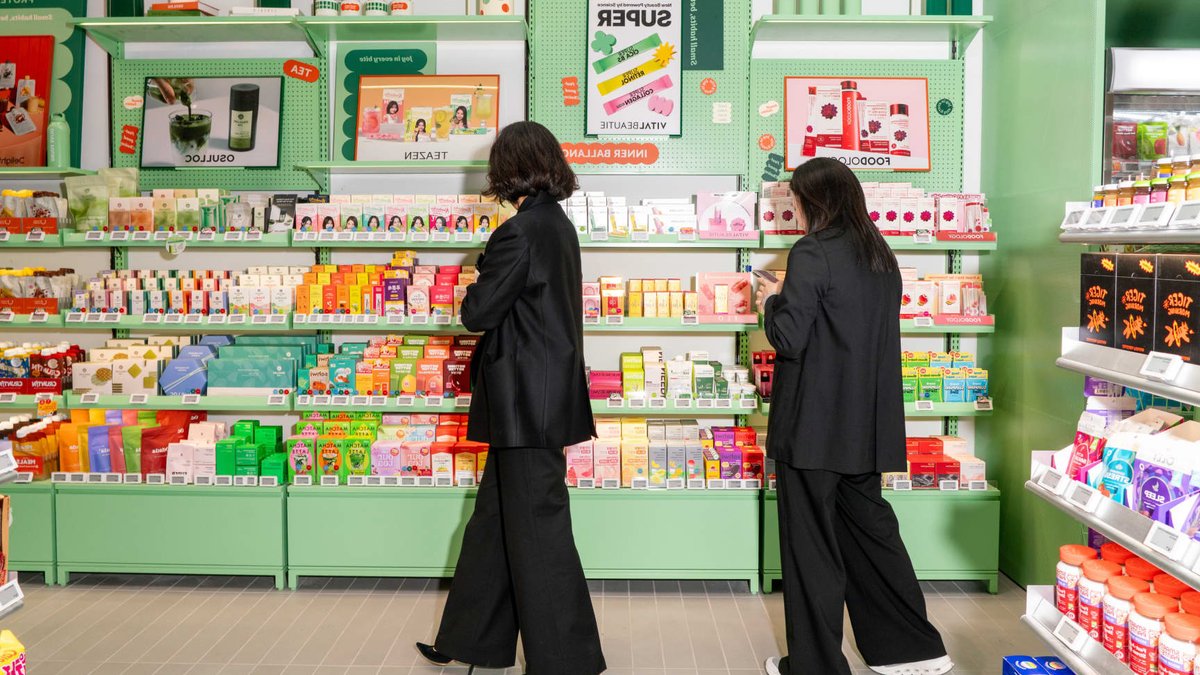
Korean beauty products are becoming mainstream in the U.S. as retailers like Olive Young see massive demand for the trend. When Olive Young opened its first U.S. outpost in late May, shoppers were already camping out, and the line spanned multiple blocks. On opening weekend, the leading South Korean beauty retailer’s new store in Pasadena, California, had 6,000 customers move through its doors, and it currently sees an average of more than 1,600 visitors per day, the company said. It has since opened another location in Century City, California, and said it plans to open more stores in the U.S.
Consumption of Korean cosmetics, otherwise referred to as K-beauty, has been on the rise in the U.S. for years, with the “first wave” taking place in the 2010s and continuing into the Covid-19 pandemic. “People were home. They had time to kind of learn about a 10-step skin care routine. They learned about what specific ingredients did, how to layer products together,” said Anna Mayo, a NielsenIQ beauty thought leader. “We saw the rise of this ‘glass skin’ look, and this real emphasis on healthy and glowing skin that looks great every day versus the need to kind of cover it up with cosmetics.”
Mayo noted that consumers have already been primed in this skin care-first philosophy that they’re kind of living in. The “second wave” has now taken hold, as K-beauty brands successfully take advantage of this appetite among U.S. consumers for skin care. According to NielsenIQ, U.S. K-beauty sales reached $2.8 billion in early 2026, representing a roughly 48% increase from a year ago. That’s faster than the nearly 45% growth rate seen in the prior-year period — an unusual acceleration, Mayo said.
Related: Fed Officials Act to Curb Inflation
K-beauty is also penetrating more U.S. households, climbing to 28.7% over the latest yearly period — a sign that it’s becoming stickier in the country. The American mall has started to be reshaped as a result. At Westfield Garden State Plaza in New Jersey, the lineup of Asian retailers has expanded over the past 12 months, seeing new additions such as Sukoshi.
Consumer discovery has fundamentally changed, said Kate Sabbag, vice president of leasing at Westfield Garden State Plaza. “People aren’t just finding brands in malls anymore — they’re discovering them on TikTok, Instagram and through international travel. And once they connect with a brand, they want to experience it in real life. We’re seeing that play out across our portfolio.”
While a huge chunk of K-beauty sales comes from platforms such as TikTok Shop and Amazon, according to NielsenIQ data, there’s room for retail to take up more market share. “There is a huge opportunity to kind of move this segment offline and into stores and reach people that way,” NielsenIQ’s Mayo said in an interview.
Related: TSMC Speeds Up Arizona Factory Expansion
Earlier this year, Sephora partnered with Olive Young to bring K-beauty products to Sephora customers in stores as well as online, and Morgan Stanley’s Gutman said Ulta Beauty is also set up to benefit from rising K-beauty popularity in the U.S. In its latest earnings report, Ulta CFO Christopher DelOrefice said “the skincare and wellness category delivered low-single-digit comp growth this quarter,” with prestige skin care, including Korean brand Medicube, continuing to “perform well.”
He said K-beauty brand Peach & Lily was among those driving “healthy guest engagement,” while mass skin care’s “solid” growth in the period was supported by the in-store expansion of Anua.
However, Glaessgen highlighted that K-beauty’s popularity poses a risk: Overall average selling price in the category could be affected given that K-beauty typically carries a lower price point than prestige skin care. “If people who normally would have been a prestige skin care shopper spending $30 to $60 on something are now spending in the teens to in the 20s, obviously that carries downward pressure to the average spend in the category,” she said.
Related: PDQ Machines Explained in Simple Terms
She sees that risk coming more from the younger generations who are just now entering prestige skin care. “If they are finding efficacy in a $20 or $30 product, it might be more difficult to get them to trade up to something running in the hundreds,” the analyst said. Other retailers such as Target, Costco and Walmart further increasing their K-beauty market penetration could also be a way to help attract a broader audience to the category.
Target has already made significant strides in that area. The retailer quadrupled its K-beauty items in the spring, offering more than 150 new products and more than 10 new brands across skin care, makeup and hair care, a spokesperson told the outlet. The company plans to introduce more products. “Beauty is an incredibly important and deeply personal category for our guests, and our team is always looking to flex our merchandising authority by bringing them the brands and trends they want most,” Amanda Nusz, senior vice president of merchandising, essentials and beauty at Target, told the outlet. “K-beauty is a great example.”
Raymond James analyst Olivia Tong noted that products from brands such as The Ordinary, which is based in Canada and owned by Estee Lauder, have incorporated ingredients that have become popularized by those in the K-beauty space, such as centella asiatica. “It’s a very different way of looking at the category — more about maintenance, very ingredient heavy, and there’s obviously a certain speed to market that they’re bringing too,” she said. “We don’t think this is just a trend per se. We think that this is a bit of a shift in the market.”


