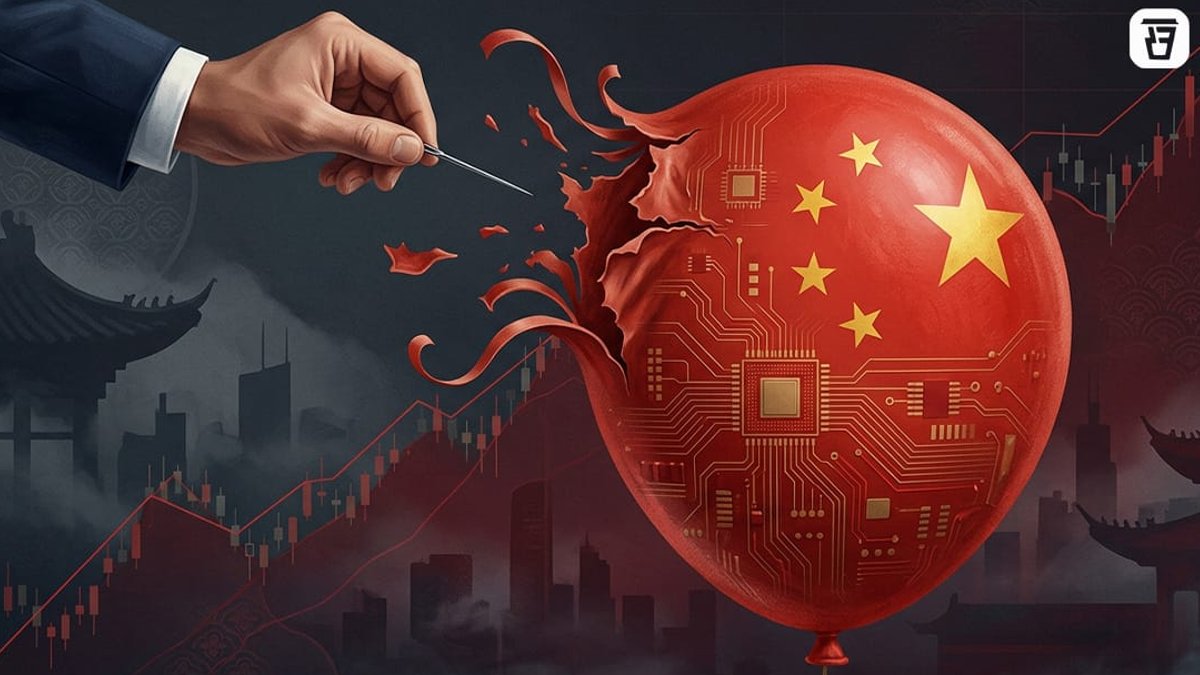
Wall Street remains divided over whether artificial intelligence represents an unprecedented technological revolution or an overinflated speculative bubble. While US markets have shown little reaction to AI’s hype, China’s AI-driven stock surge has already collapsed dramatically. The STAR 50 index, tracking China’s leading AI shares, has plummeted 40% in four months, erasing roughly $480 billion in investor capital.
This meltdown offers a glimpse of what could happen when AI hype collides with cold financial math. To understand why, it’s essential to look at how the global AI boom took shape. When OpenAI launched ChatGPT in late 2022, America’s tech giants panicked, fearing they’d miss out on the next big technological shift. Hyperscalers like Amazon, Google, Meta, and Microsoft went on a spending spree, pouring billions into building data centers packed with specialized AI chips.
China’s AI Bubble Bursts
China’s AI market has already lived through the earthquake, with the STAR 50 index crashing by 40% in just four months. This is largely due to how Beijing fueled its AI rally. Over the past two years, China wanted to revive its sluggish economy and reduce its dependence on American technology. State-backed funds began pouring money into domestic chipmakers, robotics companies, and AI labs, which led to a speculative frenzy among individual investors.
AI stocks accounted for 42% of China’s entire stock market value and 57% of all trading volume at the peak of the rally. Companies on China’s STAR 50 index were trading at nearly 250 times their annual profits, making them highly vulnerable to even small disappointments. For example, Unitree, a Chinese humanoid robot maker backed by state funds, saw its stock halve after its first post-IPO earnings report showed net profits falling 17% as research and development costs doubled.
Several other domestic chipmakers have also lost half their value since July, while optical hardware makers Zhongji Innolight and Eoptolink plunged 60% amid fears that Washington could restrict Chinese components in US data centers. Even emergency stock purchases by a state-owned firm couldn’t stop the decline. The bigger problem facing Chinese AI companies is a familiar one: price wars, which could leave everyone fighting for market share while making very little money.
Just like China’s solar and electric vehicle industries, government subsidies encouraged too many companies to build similar AI models and hardware. Now, with competition intensifying, companies may have to slash prices to survive. This could lead to a situation where companies are making very little money, despite the potential of AI to transform the global economy. In fact, the situation is reminiscent of the dot-com bubble, where telecom companies built far more capacity than customers needed, leading to a massive wipeout of investments.
For instance, back in 1996, a breakthrough called Wavelength Division Multiplexing allowed a single fiber-optic cable to carry 16 streams of internet data instead of one. Convinced that internet traffic would triple every year, telecom companies borrowed around $500 billion to lay millions of miles of cable across oceans and continents. However, when the dot-com bubble burst, roughly 85–95% of those buried cables remained unused, becoming known as “dark fibre”, while stocks plunged and dozens of telecom companies went bankrupt.
There’s an important difference between those cables and today’s AI infrastructure, though. Fiber-optic cables can sit underground for decades, waiting for demand to catch up. AI chips, on the other hand, can lose economic value much faster as newer, more efficient processors arrive. If computing capacity grows faster than customer demand, the prices companies can charge for renting out that capacity could fall sharply, making it difficult for companies to generate returns on their investments.
Global AI Reset
China’s $480 billion wipeout could well be the first casualty of a global AI reset. The technology might be here to stay, but the companies betting trillions on it still need to figure out how to make those investments pay off. And that’s a much harder problem than building the next big AI model. As the situation continues to unfold, it’s clear that the AI industry is facing significant challenges in generating enough revenue to justify the massive investments made in recent years.
One estimate suggests that the AI industry needs around $600 billion in annual revenue to generate adequate returns on its hardware investments. However, actual customer spending on generative AI is expected to reach just $64 billion this year. This significant gap between expected and actual revenue raises concerns about the sustainability of the AI industry’s current business model. The situation is further complicated by the fact that some of the revenue reported across the AI ecosystem may be supported by circular financing, where tech giants invest in AI startups, which then use that money to buy cloud computing services from the same tech giants.
The first major crack in the AI bubble showed up on what Wall Street called AI’s “Black Monday”, when a little-known Chinese lab named DeepSeek released its open-source reasoning model, proving that you could train a world-class AI model at a fraction of OpenAI’s cost using older chips. Nvidia shed $600 billion in market value in a single day as investors realized companies might not need enormous computing investments after all. This event marked a significant turning point in the AI industry, as investors began to question the massive investments made in AI infrastructure.


