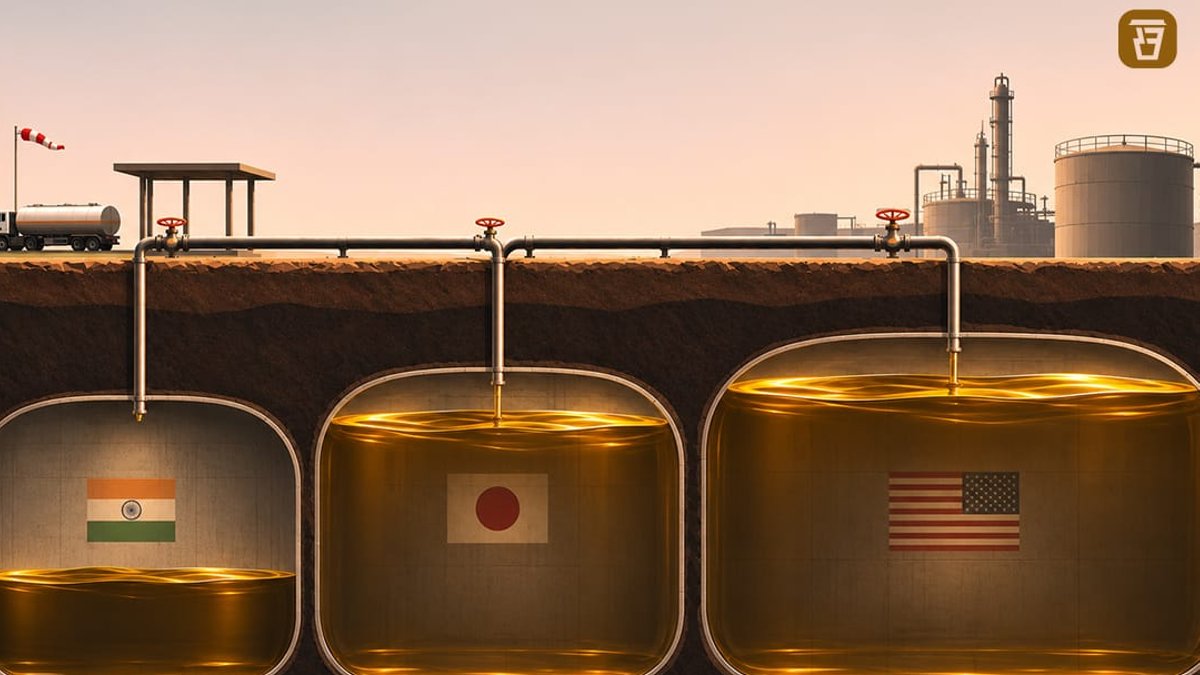
India imports nearly 90% of its crude oil, leaving it exposed to global supply disruptions. Its strategic reserves, managed by the Indian Strategic Petroleum Reserves Limited (ISPRL), can cover roughly 10 days of demand at full capacity, though current stockpiles sit at about 64% of capacity. When broader national oil stocks are included, the buffer extends to 74 days—still far below the 200+ days maintained by Japan and South Korea, which also rely heavily on imports.
Calls for expansion have grown louder, including from former Reserve Bank of India governor C. Rangarajan. However, the obstacles extend beyond policy. Constructing underground storage requires specialized infrastructure, caverns, pipelines, and supporting systems, at a cost of billions. Phase II, announced in 2021, was estimated to cost ₹15,000 crore just for construction. Filling these reserves at $70 per barrel, a price India considers manageable, would add another ₹25,000 crore, pushing total costs to over ₹40,000 crore.
This total equals nearly 40% of the Union Health Ministry’s FY27 budget. The trade-off is stark: every rupee spent on emergency oil is one less for healthcare, education, or infrastructure. The investment also yields no direct financial return. Current tensions in West Asia feel like an exception rather than the norm.
Budget mismatches block strategic oil buys
In 2020, India took advantage of a price collapse, buying crude at $19 per barrel and saving over ₹5,000 crore. Such opportunities depend on timing, though. The government’s annual budget allocations for reserve purchases often fail to align with market conditions. Last year’s allocation of ₹5,876 crore was reduced to ₹870 crore, and even that amount went largely unused.
A revolving fund system, where the government could buy low and sell high to recoup costs, could help. India tested this approach in 2020, purchasing oil at depressed prices and later selling at higher levels. However, the system requires empty storage space, clear price triggers, and the ability to sell oil quickly when prices rise. Without these safeguards, the strategy risks becoming a speculative gamble.
Delays in Phase II highlight deeper execution challenges. Bidding issues and land acquisition have slowed progress despite the expansion’s 2021 launch. Even if completed, doubling storage capacity would still leave India with just 20 days of coverage, a figure that remains modest compared to regional peers.
Joint stockpiles and foreign partnerships fall short
One possible solution is joint stockpiling. Countries like the UAE’s ADNOC now rent space in India’s warehouses, storing their own oil. In a crisis, India gains first access to these reserves. This arrangement secures supply without requiring full upfront costs. However, it does not address the core issue: storage capacity remains limited, and delays continue.
Legal mandates could drive progress. East Asian nations enforce minimum stockpile requirements, 90 days’ worth, with interim targets of 45 or 60 days. India could adopt a similar approach, tying reserves to supply risks and financial capacity. The goal is not just more days of coverage but a system that functions effectively during crises.
PPP model risks delays without strong contracts
The next oil shock will not wait for a plan. It will demand reserves that are already in place. The public-private partnership (PPP) model is now central to Phase II, allowing private companies to build and operate storage facilities with government support. Under this model, private firms lease capacity for commercial use during normal periods but must prioritize government access in emergencies. Success depends on clear contracts and enforcement mechanisms, delays in finalizing agreements or disputes over access could undermine the strategy.
Private players face practical hurdles as well. Land acquisition for cavern sites remains a bottleneck, with legal disputes and local opposition prolonging timelines. Even when projects secure approval, geological surveys to identify suitable underground formations add months to planning. Some potential sites have been abandoned after tests revealed unstable rock layers or high water tables, forcing a search for alternatives. As a result, Phase II’s completion has been pushed back beyond its original 2023 deadline.
Progress on Phase II has been inconsistent, with bidding delays and land acquisition hurdles pushing back completion timelines. Even if fully operational, the expanded reserves would still cover only 20 days of demand, a figure that pales in comparison to regional peers. The gap highlights a fundamental issue: announcing projects is far easier than executing them. Without urgent reforms in procurement, legal clarity, and funding predictability, India’s reserve strategy will remain reactive rather than resilient. The next supply shock will reveal whether these challenges have been resolved, or if they have merely been delayed.


